Moreno Valley sits on some of the most active soils in the Inland Empire. The clay-heavy ground beneath most neighborhoods expands when it absorbs moisture during winter rains, then contracts hard during the dry summer months. That constant movement puts stress on everything buried underground — including the copper water lines running beneath your home’s concrete slab foundation.
When one of those lines develops a leak, water seeps into the soil and concrete with nowhere to go. That’s a slab leak, and left unaddressed, it leads to foundation damage, mold growth, and water bills that climb without explanation.
How Slab Leaks Develop in Moreno Valley Homes
Most Moreno Valley homes were built between 1980 and 2000, during the city’s major residential construction boom. Copper supply lines from that era are now 25 to 45 years old — well into the window where corrosion, electrolysis, and soil pressure begin causing pinhole leaks and joint failures.
Three factors accelerate slab leak development in this area:
Soil movement. Expansive clay soils shift with every wet-dry cycle, putting lateral pressure on buried copper lines. Over years, that pressure weakens joints and creates stress fractures.
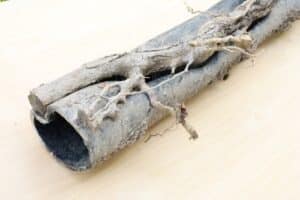
Water chemistry. The Inland Empire’s hard water is high in dissolved minerals that accelerate copper corrosion from the inside out. Homes that have never had a water softener installed tend to develop slab leaks earlier.
Construction-era practices. Copper lines installed in the 1980s were often laid directly on gravel or soil without protective sleeving. Direct contact with alkaline soils speeds up external corrosion. Our post on how poor construction practices lead to slab leaks goes deeper into this issue.
Warning Signs Every Moreno Valley Homeowner Should Watch For
Slab leaks are invisible — the pipe is buried under concrete — so you have to rely on indirect signals:
A sudden, unexplained jump in your water bill is often the first indicator. Even a small slab leak can waste hundreds of gallons per month. Our post on high water bills and slab leaks explains this connection in detail.
Hot spots on the floor — a warm area on tile or hardwood that wasn’t there before — usually mean a hot water line under the slab is leaking.
The sound of running water when every fixture in the house is off is a strong indicator. If you can hear water but nothing is on, something is leaking somewhere you can’t see.
Damp or darkened areas on flooring, especially carpet that feels wet near a wall or in the center of a room, point to moisture migrating up through the slab from a leak below.
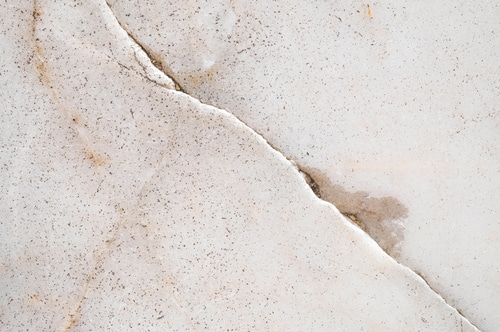
Cracks in the foundation or interior walls can develop as water from a slab leak saturates the soil and causes uneven settling. The connection between slab leaks and foundation issues is well-documented and worth understanding if you see cracks forming.
How Plumbers Detect Slab Leaks Without Tearing Up Your Floor
Modern slab leak detection doesn’t require jackhammering your foundation to find the problem. Licensed plumbers use a combination of electronic amplification equipment, infrared thermal imaging, and pressure testing to locate the leak with precision.
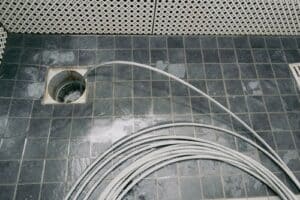
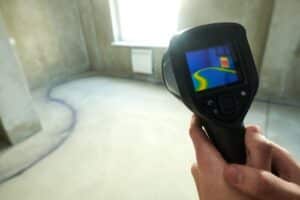
Electronic listening devices amplify the sound of pressurized water escaping through a crack in the pipe — even through several inches of concrete. Thermal cameras detect temperature differences on the slab surface that indicate where hot or cold water is pooling beneath. Together, these tools narrow the leak location to within inches, which means the repair requires only a small, targeted access point rather than tearing up an entire floor.
Our post on how plumbers detect slab leaks walks through the full diagnostic process.
Repair Options
Once the leak is located, the repair approach depends on the condition of the pipe, the location of the leak, and how many leaks are present:
Spot repair. If the leak is isolated — a single pinhole or joint failure — the plumber can cut through the slab at that point, repair or replace the damaged section of pipe, and patch the concrete. This is the least invasive and least expensive option when the rest of the pipe is in good condition.
Reroute. If the leaking pipe runs through an area where access is difficult, or if the pipe shows signs of widespread corrosion, a reroute abandons the damaged line and runs a new one through the walls or attic instead. This avoids cutting the slab entirely and eliminates the risk of future leaks in that same line.
Full repipe. If the camera or pressure testing reveals that corrosion is widespread — which is common in Moreno Valley homes from the 1980s with original copper throughout — a home repipe replaces all the supply lines at once. It’s the most comprehensive solution and prevents the cycle of fixing one leak only to have another appear six months later.
The U.S. Department of Housing and Urban Development recognizes foundation water damage as a significant factor in residential property deterioration — addressing slab leaks promptly protects both your home’s structure and its value.
Moreno Valley Slab Leak Detection and Repair
Plumbing MATTers Rooter & Plumbing Services provides expert slab leak services and water leak detection across Moreno Valley and the Inland Empire. Non-invasive detection, upfront pricing, and repair options explained clearly before any work starts. Call (909) 714-2207.