Water leaks don’t always announce themselves with a puddle on the floor. In Bloomington, where a significant portion of the housing stock dates back to the 1960s and 1970s, many leaks happen inside walls, under concrete slabs, or underground between the meter and the house. They run silently for weeks or months, driving up water bills and causing structural damage before anyone notices.
Here’s how to tell if your Bloomington home has a hidden leak — and how a professional finds it without destroying your property.
Signs You Have a Hidden Leak
Your water bill spikes without explanation. This is the most common first indicator. If your usage hasn’t changed but the bill jumped 20% or more, water is going somewhere you can’t see. Even a pinhole leak in a supply line can waste 10 to 20 gallons per day.
You hear running water with nothing on. Stand in a quiet room and listen. If you can hear water flowing when every fixture and appliance in the house is off, there’s a leak in a supply line — most likely under the slab or in a wall.
Warm spots on the floor. A hot water line leak under a slab foundation pushes heat up through the concrete. If a section of your tile or flooring feels noticeably warmer than the surrounding area, that’s a targeted indicator.
Mold or mildew smell without a visible source. Leaks inside walls feed mold growth in the dark, moist cavity between studs. You’ll smell it before you see it.
Decreased water pressure. A leak in the main supply line between the meter and the house reduces pressure at every fixture. If pressure has been gradually declining, a supply line leak is a likely cause.
For more on recognizing these warning signs early, our post on water leak detection for Riverside homeowners covers additional indicators — and the same principles apply in Bloomington.
The Meter Test: A Simple DIY Check
Before calling a plumber, you can confirm whether you have a leak with a simple test. Shut off every water-using fixture and appliance in the house — faucets, toilets, dishwasher, washing machine, ice maker, irrigation system. Then go to your water meter and check the flow indicator (the small triangle or dial on the meter face). If it’s moving, water is flowing somewhere in your system despite everything being off. That confirms a leak.
This test tells you a leak exists. What it can’t tell you is where.
How Professional Leak Detection Works
Licensed plumbers use non-invasive technology to locate leaks with precision:
Acoustic detection equipment amplifies the sound of pressurized water escaping through a pipe wall. Different pipe materials and leak sizes produce different sound signatures, and trained technicians can distinguish a leak sound from normal pipe noise. This works through concrete slabs, inside walls, and underground.
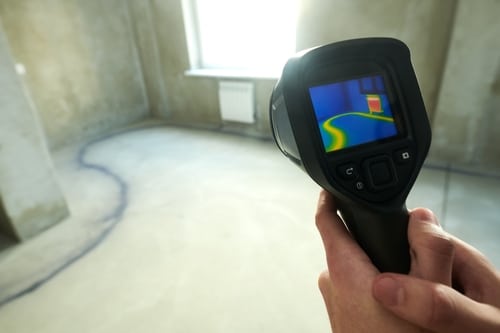
Infrared thermal imaging detects temperature anomalies on surfaces. A hot water leak under a slab creates a warm zone that shows up clearly on a thermal camera, even when the surface feels normal to the touch.
Pressure isolation testing sections off different zones of the plumbing system to narrow down which line is leaking — hot vs. cold, interior vs. exterior, supply vs. drain.
Combined, these methods locate leaks within inches — which means the repair involves a small, targeted access point rather than exploratory demolition. Our dedicated water leak detection service page details the full process.
Why Bloomington Homes Are Especially Vulnerable
Bloomington is an unincorporated area of San Bernardino County, and much of the residential construction predates modern plumbing standards. Galvanized steel supply lines — common in homes built before the 1970s — corrode internally over decades, developing pinhole leaks that are nearly impossible to see. Copper lines in homes from the 1970s and 1980s are susceptible to electrolysis and soil-contact corrosion.
The San Bernardino County Department of Public Health monitors water quality and infrastructure standards for unincorporated communities, but the plumbing inside your home and the lateral from the meter to the house are your responsibility. Regular inspection and prompt leak repair protect both your property and your water bill.
If leak detection reveals widespread pipe corrosion, a home repipe may be the most cost-effective long-term solution rather than chasing individual leaks as they appear.
Bloomington Leak Detection — Fast and Non-Invasive
Plumbing MATTers Rooter & Plumbing Services provides professional leak detection across Bloomington and the Inland Empire using advanced acoustic and thermal technology. No guessing, no unnecessary demolition, and upfront pricing on every repair. Call (909) 714-2207.